

Periodontal Disease – Loose Teeth, Bleeding Gums

Bleeding Gums, Receding Gums, and Loose Teeth – Why it happens and what you can do about it?
Periodontal Problems (Gingivitis & Periodontitis):
Perio-dontal means: “around the tooth”. It is basically an infection that happens around the tooth.
Periodontal “disease” is a term that is sometimes used to describe both an inflammatory condition of the gums (gingivitis) and an inflammation around the tooth (periodontitis).
It is second only to the common cold as the most prevalent infectious ailment. It is the major cause of adult tooth loss. It is more prevalent in people over 50.
Healthy gums are pink and do not bleed.
What is Gingivitis?
Gingivitis is characterized by gum redness, changes in the gum, and bleeding. It is essentially painless.
It is created when plaque (sticky deposits of bacteria, mucus, and food particles) adheres to the teeth, hardens, and irritates the gum.
The accumulation of this plaque causes the gums to become infected and swollen. As the gums swell, pockets form between the gums and the teeth and act as a trap for more plaque. It can then become sore, bleeding gums when brushing your teeth. The irritated gums bleed and eventually start to recede.
Irritation can be fought by introducing Vitamin C, which fights the formation of plaque. Formation of plaque can be due to high levels of calcium that is not being absorbed during digestion. This can be due to low stomach acid or any other inability to absorb calcium. Improving Digestion is also. recommended. See below.
(See below for Vitamin C that can best be assimilated and used)
What is Periodontal Disease?
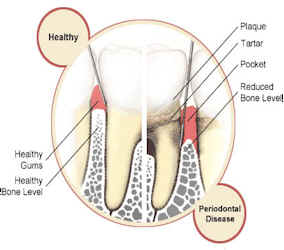 Gingivitis, untreated, can progress to periodontal disease or pyorrhea. The bacteria-plaque starts attacking the root of the teeth and the jawbone, and if not treated, you might even lose some teeth.
Periodontal means “located around the tooth”.
Periodontitis is characterized by localized pain, loose teeth, pockets between the gum and the tooth, redness, swelling, and/or signs of infection.
X-rays may reveal destruction of bone. This is because the bone supporting the teeth begins to erode due to the infection. Abscesses are common. There is sometimes halitosis, with bleeding, and often, painful gums.
Although oral hygiene is of great importance in treating and preventing periodontal disease, it is not sufficient in most cases.
Good nutrition and immune system health need to be addressed if the development and progression of the disease are to be controlled.
What causes Periodontal Disease?
Bacterial plaque is the causative agent in most forms of periodontal disease. (This can be addressed; read on.) However, it is now widely accepted that poor nutrition, wrong foods (refined foods such as white flour and white sugar), constipation, chronic illness, glandular disorders, blood disease, smoking, drugs, and excessive alcohol consumption as well as poor immune function, make an individual prone to bacteria and thus to periodontal disease.
Some experts question whether periodontal disease is a chronic, unrelenting condition and instead suggest that it gets worse or gets better depending on the response of the immune system.
What to do about periodontal problems
Helpful Periodontal treatments:
Diet: Vegetables and fiber should be the mainstay of the menu. Vegetables & fruits enhance enzyme function. Fermented dairy products, such as yogurt, help maintain intestinal health
Calcium can be gotten either from milk or vegetables. However, calcium is easier for the body to digest from vegetables
Increase your intake of sardines, canned salmon, dark green leafy vegetables (spinach, collards, kale, turnip greens, mustard greens) broccoli, Brazil nuts, tofu and all soy products, sunflower seeds, and hulled sesame seeds.
It is advised to stop using or consuming items that cause calcium to become deficient and or toxic. This includes products such as ice cream, fruit yogurt, tea, coffee, cigarettes, and aluminum. (Check your deodorant for aluminum.)
The key dietary recommendation for gum problems is to avoid sugar. Sugar is known to significantly increase plaque accumulation by depleting Vitamin C.. Sugar destroys vitamin C.
Phase out soft drinks. Canned soda contains excess phosphorus, a mineral that could lead to the leaching of calcium from your bones. Calcium is first robbed not from your hips or spine but from your jaw, leading to tooth loss.
Deficiencies of vitamin C, bioflavonoids, calcium, folate (B9), or niacin is related and can make it worse
Anything that improves health overall and the body’s ability to build health will affect the mouth positively.
Exercise: Exercise that stresses the long bones in the body – jumping rope, basketball, tennis, jogging, walking, rebounding on a trampoline, cycling, and dancing are all effective in helping with this type of problem. Vitamin D is needed for calcium absorption, so getting outdoors in the sun is advised.
In order to increase and create healthy gums & teeth:
- Get onto a healthy diet and improve your digestion.
- Increase Vitamin C
- Eliminate any infection already in your mouth.
Supplements for dental health:
Vitamin C is one nutrient that has a very positive effect on the mouth. Vitamin C is vital for the production of collagen, the basic protein building block for the fibrous framework of all the tissues, including gums. There is a lot that Vitamin C does but for your mouth……
Vitamin C strengthens weak gum tissue and makes the gum lining more resistant to penetration by bacteria.
A good form of Vitamin C that is easy for the body to use, as it is whole food nutrition, is Dr. Berg’s Vitamin C. It should be taken per directed or twice the recommended for gum problems. This really is a different type of Vitamin C that we recommend You need a whole food Vitamin C, not man-made versions (sometimes called ascorbic acid) is not going to help you or bring about the change you need.
Improving Digestion & Metabolism – whenever you find deficiencies, it can be because your digestion is not what it should be. Improving Metabolism
Natural Plant-based “Toothpaste.”
The major cause of all gum, tooth, and breath problems is the overproduction of plaque bacteria and pathogens in the mouth. Thus, if you had a solution that was stopping this bacterium from forming, it would be a successful formula. If, at the same time, it was almost impossible to wash away, then you would have an extremely successful solution in your hands!
The Dental Pro 7 liquid is easy to apply and takes up only two minutes of your day (it can be worked in to your normal tooth-brushing routine).
There is a 100% satisfaction money-back guarantee. So you can try it out and see the results for yourself.
RECOMMENDED:
Treatment for Gum and Periodontal problems: (Plant Medicine)
Dental Pro 7 – Is an All Natural, Super Strength Dental Solution
Treatment for Gingivitis, Bleeding Gums & Loose Teeth
This is an all-natural, highly effective dental product created for total tooth and gum health, as well as overall dental hygiene. The ingredients are natural enemies of bacteria and plant-based.
This product tackles the problems associated with periodontitis, gingivitis, and receding gums, and is also an extremely effective chronic bad breath product.
It is an oil, and it gets under your gum line, down in the pockets between your gums and teeth, and does not wash away like other products. It lingers and therefore prevents the bacteria from “reforming”. That is the secret to success.
It has recently been improved to be 300% more effective. It has pretty impressive statistics.
It is made from natural plant extracts that kill the bacteria that are the primary cause of gum problems, bad breath, and gum infections.
It is ultra-long lasting, fast acting, water insoluble (won’t wash away), and it’s even quick and easy to use.
100% Natural. It’s an anti-bacterial, anti-fungal and anti-viral formula, and it will also help to heal abscesses, ulcers, infections, sore throats, oral thrush, and chronic bad breath.
It is also risk-free with a 90-day (3-month) guarantee.
Here are the benefits of this product.
It’s Water Insoluble: Which means it will penetrate deep down inside the gum tissue and NOT WASH AWAY (this is the secret to its great success and the reason why 99.9% of other products don’t work)
It’s Fast Acting: You can actually ‘SEE’ and ‘FEEL’ results within days instead of months.
It’s scientifically proven: The extracts are scientifically proven to kill the bad bacteria in your mouth (2), and also the specific pathogens (P. gingivitis and A. actinomycetemcomitans) that can lead to unhealthy teeth and gums.
It’s 100% natural: You no longer have to put harmful chemical toothpastes and irritants into your mouth (most of which can make your teeth even worse).
Helps gum, tooth, and breath health: It is the only solution to contain an impressive arsenal of 10 separate antibacterial and antioxidant extracts to help your unhealthy gum, teeth, and breath problems from every angle possible.
It kills bacteria FAST: in a recent study using the actives contained in this formula, all oral bacterial strains tested (the bacteria that can cause unhealthy teeth and gums) were completely killed in under 30 seconds.
Replaces your toothpaste and mouthwash: You will never have to buy ineffective and potentially harmful dental products ever again.
It’s ultra-long lasting: ONE large bottle can last over 6 months!
It’s quick and easy to use: It takes less than 2 minutes to use (brushing twice a day)
It has a Minty Flavor that Helps Freshen Breath.
This is what the person who created this product has to say:
“How I Discovered an All Natural Solution To My Horrible Teeth and Bad Breath……That takes me less than 4 minutes a day to do”
From the desk of Daniel Sanderson
May 22, 2010
Dear Friend,
Are you worried about the health of your teeth and gums? Are you certain you are using the best possible dental products available?
My name is Daniel, and I’ve been showing people a little known ‘All Natural’ solution to get healthier teeth and gums for over 7 years now…. and I guarantee I can help you too
Back in 2003, I like many of you, was suffering with horrible teeth and bad breath, I was brushing 2-3 times per day, flossing and even using mouthwash after every meal…. yet I was seeing no improvement in my oral heath whatsoever… And then it occurred to me…
“If commercial toothpastes and mouthwashes actually worked, then why do the millions of people that use them still have unhealthy teeth and gums?”
…So I set out to find my own solution
What if it was possible to create a much more powerful dental product that actually worked and that could actually transform my unhealthy teeth and gums?
So over the next few months I had read just about every single book on the subject you could imagine… and even though I knew more than ever before, I was still just treading water.
….until one day I stumbled upon a study in an old medical journal, it explained how certain plant extracts could completely kill multiple strains of oral bacteria in the mouth (the exact type of bacteria that can attack the teeth and gums) in under 30 seconds (for clinical references see below*)
I excitedly ordered all the extracts and immediately began my experiments!
After about 5-6 weeks of formulating different solutions, I’d finished, I’d created an extremely powerful ‘All Natural’ solution that would potentially kill the all harmful bacteria in the mouth and penetrate deep down inside the gum tissue… I also made sure the solution wasn’t water soluble (unlike all the other products I’d tried in the past) so it wouldn’t wash away!
I brushed my teeth with the new solution and ‘WOW’ my entire mouth felt great…
…But after just 2 weeks of use I noticed something else had happened, something quite special;
My teeth were now gleaming white, my bad breath was completely gone and my gums were looking the healthiest they’ve been in years!!!
You see; the primary cause of unhealthy teeth, gums and bad breath is the overproduction of ‘bad’ bacteria and pathogens in the mouth… if my new solution was stopping this bacteria from forming while at the same time being almost impossible to wash away, then I would have an extremely successful solution on my hands!
…I had to find out if I was right
I immediately listed my new solution (now called Dental Pro 7) on eBay… I made a dozen sales in the first week alone, but more importantly the feedback I received was just amazing:
Cant believe this product… felt better in two days a++++++
– thomson3116
Cannot believe the effect in just one day. Fantastic item. Speedy del. +++++++++
– theozziend
Bad breath is gone! Great stuff, easy to use, and it works!
– subliminal911
i can see the difference my gums don’t feel sore
– fungirl230
have been using for 4 days now , its amazing stuff !!
– allisonmikey
this product worked almost immediately, very pleased with results
– jeffhenzler
This stuff is amazing, 100% better -highly recommended –
– christinej1956
Initial reaction is; WOW! Fantastic. Every one should be using this
– pdbpoet1958
Seems to be working already, Thank you!
– zita1541
this is my second purchase I will not go back to toothpaste and mouthwash
– wooleymonkey61
A repeat purchase from an excellent trader – AND this works! HIGHLY RECOMMENDED+
– brendantownsend
Another Success:
“This is Chris of MCVitamins.com. The treatment I recommend is one I use myself. I had problems with my teeth and my dentist recommended that he pull some because you “can’t stop periodontal disease”, much less reverse it. Well, no, I don’t buy that.
I searched and found this product. I like that fact that it uses Plant Medicine. I was very pleased with the results. No more problems, no more soreness, no more receding gums. And I didn’t have the plague buildup that I had before. And I was surprised when someone asked me, what are you doing for your teeth, they are so white. Hey, an added bonus. You can see the above success stories. I want you to know, it is true.
2022 – Yes, I still use this product. I do wish I had found it earlier so that I wouldn’t have had teeth removed or suffered from pain. This formula really handles any infection and quickly. I love it
=Chris
The Active ingredients in one bottle of Dental Pro 7 are estimated at over 700% more concentrated than the leading antibacterial dental gel.
The price of Dental Pro 7 for a 2 month supply for $59.97 + $5 shipping
Yes a professional dental solution for under $60… you probably can’t even get a dentist to ‘look’ at your teeth for that price. Each bottle is 10 ml.
The cost also includes any assistance you might need to ensure that you get the best possible results. (Please tell me if you want to try the formula so I can make sure I keep in touch and assist you).
And it’s really not expensive if you realize how long it lasts and how it handles the problem. I’d much rather use this as a dental solution and not have to have my teeth “professionally cleaned” every six months.
MCVitamins will work with you on an individual-by-individual basis to help you get the results you seek. And don’t be surprised if we contact you so we can check up on how you’re doing and to see if we can help you to get things moving faster!
Ingredients and Frequently Asked Questions
Want to Know More? Go to Dental Pro 7
Are you in the UK or EU? Go to DP7
STILL HAVE QUESTIONS? EMAIL or Call 818 252-1038 AND GET YOUR QUESTIONS ANSWERED.
References:
*Clinical References & Scientific Studies
(1) Takarada K, Kimizuka R, Takahashi N, Honma K, Okuda K, Kato T. A comparison of the antibacterial efficacies of essential oils against oral pathogens. Department of Microbiology, Tokyo Dental College, 1-2-2 Masago, Mihama-ku, Chiba 261-8502, Japan. Oral Microbiol Oral Microbiol Immunol. 2004 Feb;19(1):61-4
(2) Shapiro S, Meier A, Guggenheim B. The antimicrobial activity of essential oils and essential oil components towards oral bacteria. University of Zurich, Switzerland. Oral Microbiol Immunol. 1994 Aug;9(4):202-8.
(3) Menezes SM, Cordeiro LN, Viana GS. Punica granatum (pomegranate) extract is active against dental plaque. J Herb Pharmacother. 2006;6(2):79-92.
(4) Sastravaha G, Yotnuengnit P, Booncong P, Sangtherapitikul P. Adjunctive periodontal treatment with Centella asiatica and Punica granatum extracts. A preliminary study. J Int Acad Periodontol. 2003 Oct;5(4):106-15.
(5) Sastravaha G, Gassmann G, Sangtherapitikul P, Grimm WD. Adjunctive periodontal treatment with Centella asiatica and Punica granatum extracts in supportive periodontal therapy. J Int Acad Periodontol. 2005
(6) 41. Aslam MN, Lansky EP, Varani J. Pomegranate as a cosmeceutical source: pomegranate fractions promote proliferation and procollagen synthesis and inhibit matrix metalloproteinase-1 production in human skin cells. J Ethnopharmacol. 2006 Feb 20;103(3):311-8.
STILL HAVE QUESTIONS? EMAIL or Call 818 252-1038 AND GET YOUR QUESTIONS ANSWERED.
See information on Gum Disease without Periodontal Disease
Once you have handled your bleeding gums and irritated mouth, you may want to build back the bone and ligaments that hold the tooth in place. If there is still loose teeth, you go on to Building a Healthy Mouth
Sign up to receive the MCVitamins Newsletter!
Up-to-date info on the latest health-related news happening in the world
(available in English only)